
Tea
As we’ve seen, it’s no exaggeration to say that tea has been the cause of wars. Our worldwide addiction to tea and coffee draws light to the psychosensory qualities of these beverages, and how their chemical make-up alters consciousness. As Michael Pollan writes in his book This is Your Mind on Plants, ‘what really commends these beverages to us is their association not with wood smoke or stone fruit or biscuits, but with the experience of well-being – of euphoria – they reliably give us’.
There are drinks that taste far better than tea and coffee, so why is it that we have tea culture and coffee culture, and there are shops and cafés dedicated to both?
A study published in the journal Psychopharmacology found that people who drank black tea were able to de-stress more quickly than those who drank a tea substitute; the scientists found that tea has an effect on stress hormone levels in the body. Professor Andrew Steptoe, UCL Department of Epidemiology and Public Health, reported that, ‘our study suggests that drinking black tea may speed up our recovery from the daily stresses in life.
Although it does not appear to reduce the actual levels of stress we experience, tea does seem to have a greater effect in bringing stress hormone levels back to normal. This has important health implications, because slow recovery following acute stress has been associated with a greater risk of chronic illnesses such as coronary heart disease.’
Steptoe says that the ingredients of tea are so chemically complex that scientists don’t know which are responsible for the effects on stress recovery and relaxation: ‘ingredients such as catechins, polyphenols, flavonoids and amino acids have been found to have effects on neurotransmitters in the brain, but we cannot tell from this research which ones produced the differences.’
TEA BAGS / LOOSE LEAF
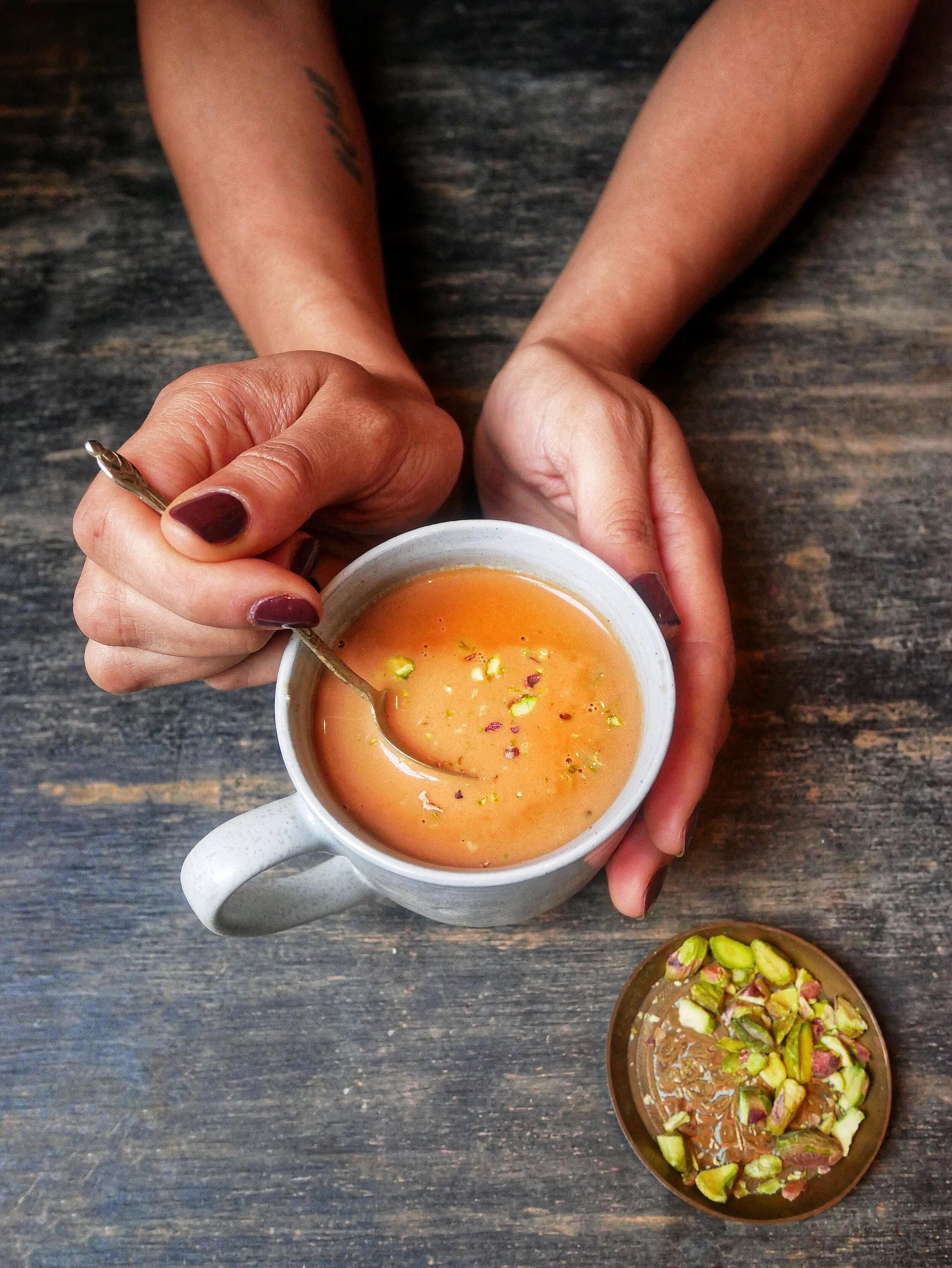
Any good black loose-leaf tea, for example Assam or Darjeeling, can be used for making chai. The important thing is that it needs to have good depth of flavour and colour, so that the taste of the tea really comes through.
While teabags are more convenient than loose-leaf tea, because you need not worry about straining the brewed tea, you are compromising on the quality and flavour of the tea.
Most teabags are filled with the leftover dust from broken tea leaves, i.e. what remains after the quality leaves have been used for loose tea, hence it is generally lower grade. Loose-leaf teas are generally fresher and more aromatic. Teabags are also, in most cases, too small to allow leaves the space to unfurl, and this is another reason why they are generally filled with ‘tea dust’.
When you steep larger or whole leaves, the essential oils and minerals they contain are released into the water, whereas tea dust lacks much of these oils and aroma in the first place, hence you get fewer nutrients and much less flavour all round. With loose-leaf tea, the leaves ‘bloom’ and are in contact with more of the water, providing a stronger flavour. You are also often paying more for teabags, as compared to loose-leaf, and while teabags are designed to be thrown away after using once, with loose tea you can brew the leaves several times.
However, there is, of course, a whole range of teabags out there, and the high-end good-quality teabags are larger and do use whole leaves. So make sure you pick the right ones. Loose-leaf teas with smaller, broken leaves will also infuse better than full-leaf teas, so try to use varieties that are processed using the CTC (Crush, Tear, and Curl) method. As with many ingredients, organic teas are generally more flavourful than non-organic varieties, as well as often being healthier and better for the environment.